LEGO
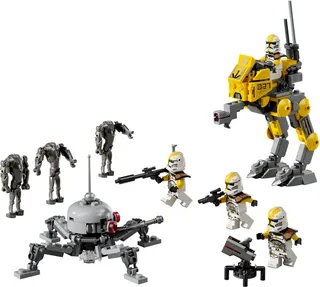
327th Star Corps Clone Troopers™ Battle Pack
- Solo afternoon brick build (Ages 7+)
- Building set contains 258 pieces
- Ages 7+ · Building & construction
LEGO
(Building set contains 258 pieces · Ages 7+)
258-piece Star Wars set with four Clone Troopers, three Super Battle Droids, a posable AT-RT walker, and a Spider Droid.
Solo afternoon brick build (Ages 7+)
Thames & Kosmos
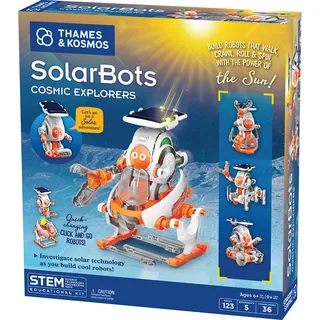
(Build five solar-powered models using a reusable robot core and 123 construction pieces · Models include a walking robot, bug, tricycle and orbiting platform · 6+ with Help / 9+ I got this!)
Uses a reusable solar-powered motor core and 123 pieces to build five walking, rolling, and orbiting models in direct sunlight or under a halogen lamp.
Ages 8+ · Multi-experiment chemistry & physics
Educational Insights

(Code drawing instructions and watch the robot trace the design with washable markers · Connect a computer or tablet directly to the robot to work with programming tools including Blockly and Python · 7 years and up)
Artie 3000 connects directly to a tablet or computer over built-in Wi-Fi (no internet needed) and plots programmed designs with washable markers; requires 4 AA batteries.
Visual coding on real paper (Ages 7+)
Educational Insights
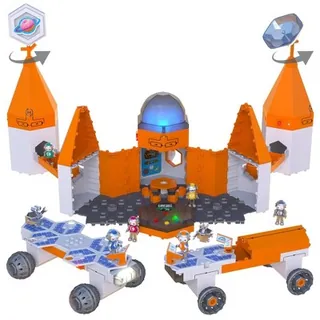
(Connect circuit pieces to build a base station with lights, moving features and sound effects · Includes a planetarium dome, rotating radar dish and rover builds · 6 years and up)
Circuit Explorer Deluxe Base Station connects oversized conductive tracks to power a planetarium dome, rotating radar dish, and rover; requires 9 AAA batteries.
Tablet-free circuit building (Ages 6+)
Thames & Kosmos
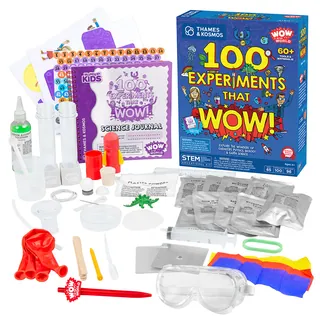
(The guide contains 100 activities involving topics such as air pressure, magnets, light and color · Projects include an underwater volcano, dinosaur excavation, musical instrument and rocket · Ages 6+)
Includes 65 lab pieces for 100 air-pressure, magnet, light, and sound experiments; requires adult supervision and a pump for the included latex balloons.
Parent-and-kid weekend science lab (Ages 6+)
Hans im Glück
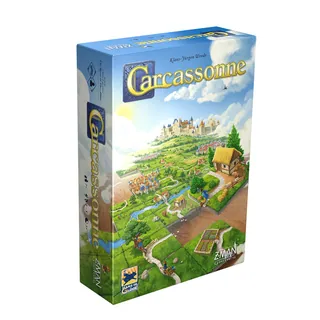
(Player count: 2–5 · Manufacturer play time: 45 minutes · Ages 7+)
Plays 2 to 5 players in 45 minutes as you build medieval roads, cities, and monasteries tile by tile; this edition includes The River and The Abbot expansions.
Family strategy game night (Ages 7+)
Ages 6–8 years · Independent builds, circuits & strategy games
Between ages six and eight, kids cross a major independence threshold: they can read step-by-step manuals, sort small parts without losing half the bag, and play board games where strategy beats luck. Gifts land best at this age when they respect that new autonomy by giving kids a complete 250-piece build, a coding robot that draws real geometry on paper, or a 65-piece science lab they can work through over several weekends.
Six- to eight-year-olds can follow exploded diagrams on their own when pieces snap together cleanly, which makes 200- to 300-piece LEGO sets with opposing vehicles and minifigures an easy afternoon win. When you move from standard bricks to mechanical STEM kits with gears and sprues, pay attention to split age guidance.
Thames & Kosmos marks several mechanical kits as '6+ with help / 9+ I got this!' because snipping plastic parts cleanly from a frame and aligning small spur gears takes adult hands at age six or seven, even though a six-year-old will happily run the finished solar robot across a sunny patio.
Screen-only coding apps often feel like schoolwork, while robots that simply roll across the rug lose their novelty once a seven-year-old maps the hallway. A drawing robot bridges the gap between code and art: kids write loops in drag-and-drop Blockly (or Python later on) over built-in Wi-Fi, drop a washable marker into the chassis, and watch the robot plot mandalas and geometric shapes on a sheet of paper.
Seven-year-olds love variety in science kits, provided they do not run out of activities on the first Saturday. A 100-activity lab covering air pressure, magnetism, light, and acoustics works well as a parent-child weekend project; check the manual’s household-supply list and balloon supervision notes before opening the box.
At the game table, age seven is when kids can play the full adult rules of Carcassonne. Because every turn consists of drawing one landscape tile, matching roads or city walls, and deciding whether to place a wooden follower, seven-year-olds compete evenly with adults without having to read a hand of text-heavy cards.
Gifts that treat 9- to 11-year-olds like capable builders and strategists: asymmetric tabletop games, multi-microphone robots, and mechanical anatomy kits.
Compare 6 picks & specs →Avoid one-and-done science boxes by comparing reusable Snap Circuits, screen-free vs. Python robots, digital LCD microscopes, and real chemistry labs.
Compare 6 picks & specs →Match the box to the table: 15-minute wooden dexterity and push-your-luck dice games, 30-minute family strategy boxes for up to 7 players, and solo logic trays.
Compare 6 picks & specs →Choose 2–4 toys. Compare the stated facts, then check the retailer’s listing.
As an Amazon Associate I earn from qualifying purchases.